Document
Document
File Name
Rapport physique du projet ‘’chaine de valeur de quelques plantes médicinales utilisées et connaissances traditionnelles associées dans quelques centres urbains au Bénin’’.pdfFile Type
PDF DocumentFile Size
3.9 MBCreated Date
2022 Sep 13Updated Date
2022 Sep 13Published on
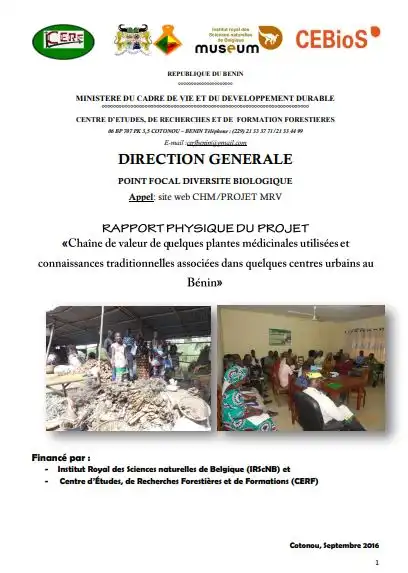
2016 Sep 01Value chain of some medicinal plants used and associated traditional knowledge in some urban centers in Benin
With the Royal Institute of Natural Sciences of Belgium (IRSCnb), the financing of 30.69% of the project “Value chain of some medicinal plants used and associated traditional knowledge in some urban centers in Benin” was initiated to meet the objectives 14 and 18 of Aichi. This project aims to provide information on some biodiversity indicators at the national level. It is about discovering the value of plant species and their uses by indigenous populations. The methodology adopted is based on ethnobotanical surveys among female sellers of medicinal plants and holders of proven traditional knowledge. The analysis of the data showed that two hundred two (202) plant species grouped into 178 genera and 78 families were identified. The Rubiaceae (67 species) and the Fabaceae (61 species) are the most represented. These species are used in the preparation of 519 recipes to treat 49 diseases. The biological spectrum shows a predominance of phanerophytes (65%). The phytogeographic spectrum shows a dominance of Guineo-Congolese species (27.47%) and pantropical species (24.40%). Leafy stems (45%) and roots (37%) are the most used organs. Decoction (70%) and maceration (15.82%) are the pharmaceutical forms most frequently recorded. The result of the statistical tests (Xsquared = 164.65, p-value =0.01605) shows on the one hand that the annual income of the respondents depends on age, on the other hand that the most used traditional knowledge transfer (CT) networks are that of family ties. The hierarchical classification led to the distribution of the 49 diseases treated into six pathology groups. The pathology groups (motor disorders; circulatory disorders and water retention; psycho-emotional; physical fatigue) have treatment similarities with the same plants as the pathology groups (dermatological disorders and cultural effect). On the other hand, the groups of pathologies (reproductive organ disorder; blood infection; gastrointestinal disorders; metabolism) are treated by different medicinal species. The Rarity Index (Ri) of species such as Gardenia ternifolia (89%), Caesalpinia bonduc (89%) and Xylopia aethiopica (89%) are above the rarity threshold (80%), so they are qualified as rare species. A conservation program must be developed for the sustainability of medicinal plants. The result of the data analysis was put in the form of a technical sheet and a poster to further valorize traditional knowledge and the collected herbariums were scanned to create a directory of medicinal plants.