Document
Document
File Name
Traditionnal knowledge on millet ‘’pennisetum glaucum’’ genetic resources conservation in Bénin ‘’local taxonomy and cultivar characteristics’’.pdfFile Type
PDF DocumentFile Size
620 kBCreated Date
2022 Sep 22Updated Date
2022 Sep 22Published on
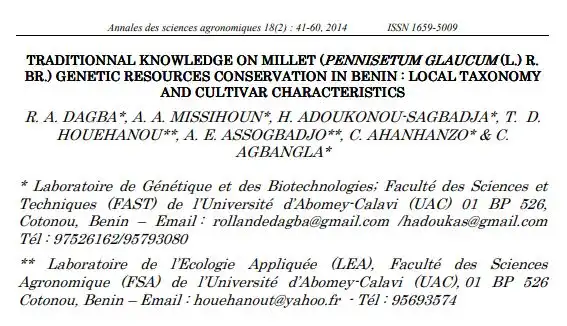
2020 Jul 01TRADITIONAL KNOWLEDGE ON MILLET (PENNISETUM GLAUCUM (L.) R. (L.) R. BR.
Little millet (Pennisetum glaucum (L.) R. Br. ) is one of the ancient cereals, grown in Benin and which plays an important role in food security in rural areas. Despite its assets and potential, it is considered a secondary crop and its production is weakening day by day. To better valorize this important genetic resource in Benin, an ethnobotanical survey based on a participatory approach was conducted in 32 villages selected from four agro-ecological production areas (Far North Benin Zone, North Benin Cotton Zone, North Benin Cotton Zone, South Benin Cotton Zone, South Borgou Food Zone and South Borgou Food Zone and West-Atacora Zone) in order to document endogenous knowledge related to its production, production constraints, cultural practices, local taxonomy, and geographic distribution of cultivars and the various uses made of its cultivars. Statistical analysis tools such as Analysis of Variance (ANOVA) and Correspondence Factor Analysis were used to describe the variation in cultivar numbers by agroecological zone and specific uses by ethnic group and agroecological zone respectively. The study revealed the existence of a very low local diversity of cultivars (1 to 3 per village per household), the highest diversity was obtained in the extreme northBenin zone (2.20 ± 0.20) and the lowest in the South Borgou food zone (1.16 ± 0.16) and the West-Atacora zone (1.00 ± 0.09). The vegetative cycle (84.38%) and the color of the grains (71.88%) are the main criteria for the nomination and differentiation of cultivars. Cultivation practices in these areas are similar and millet grains are often kept in the attic (70.54%). A new form of conservation in gourds has been observed among the Tchila in the West-Atacora zone. In total, 7 constraints were identified and prioritized, the most important of which are skin irritation (itching) (overall score = 7.17) and weeding (overall score= 6.27). Millet is mainly grown for food (59.09%), cultural (11.48%) and commercial (51.22%) purposes. These results are useful to guide studies of the genetic diversity of small millet in Benin and to define appropriate strategies for its conservation.